THE QUESTION
Can you build a reconnaissance drone at home that stays in the air for hours and carries its own BLE scanning antennas?
See it on a simulated missionOFFENSIVE LAB / FLYRECON · R&D IN PROGRESS
Can you build a drone at home that stays up for hours and scans the radio world around it?
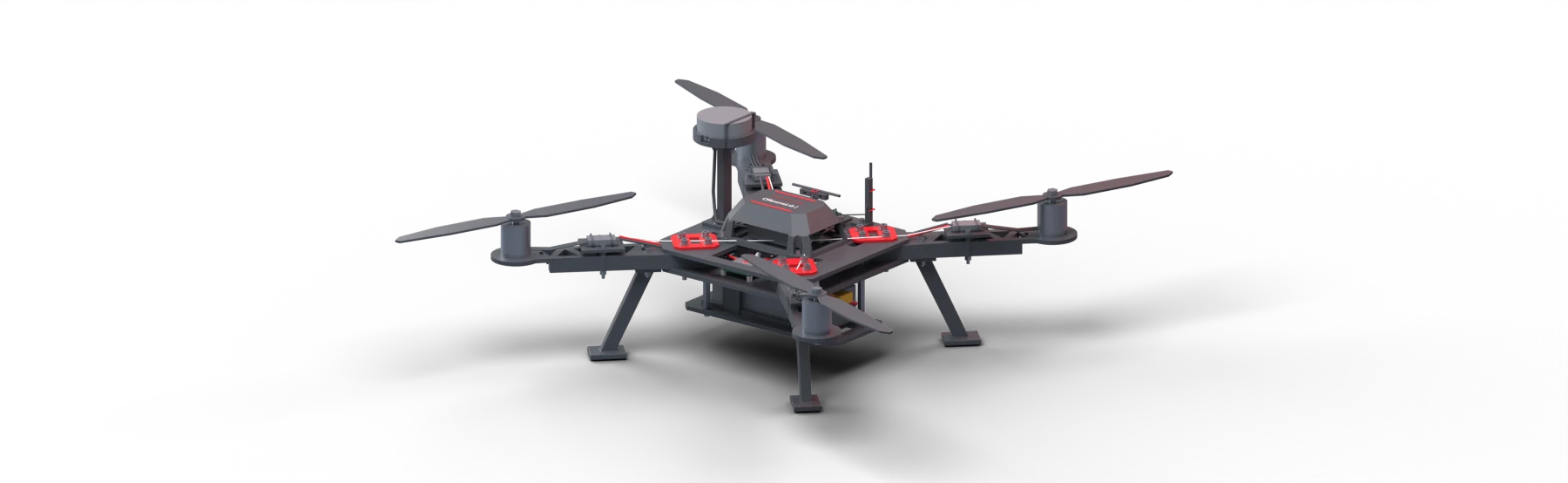
FlyRecon is chasing the answer. The RM500 is its first iteration, and every one of its parts is here in 3D.
Drag to rotate
Every iteration goes further. This one comes apart before your eyes.
motor to opposite motor
T1045II, 93.6 mm tip clearance
13 designs + a test coupon
upper bound, 100% infill
Tattu G-Tech 35C, XT60
build cube, every part fits
THE PROJECT
FlyRecon moves in iterations, each one designed, printed and tested in the lab. The RM500 is where it starts.
THE QUESTION
Can you build a reconnaissance drone at home that stays in the air for hours and carries its own BLE scanning antennas?
See it on a simulated missionAim for hours in the air. Mass, battery and propeller efficiency are the levers of every iteration.
Onboard BLE scanning antennas log every device in range, straight from the sky.
A PETG frame printed on a 246 mm printer, off-the-shelf electronics, assembled by hand.
| 01DesignComplete Blender model: 159 objects, 25 parts, zero interference | Done |
| 02Print and assembly14 print-ready STLs, the drilling coupon first | In preparation |
| 03Scanning payloadBLE antennas and in-flight logging | R&D |
| 04EnduranceHours of flight per sortie | Goal |
MISSION PREVIEW
A simulated survey flight: the drone follows its waypoints, listens for BLE devices and logs every detection. Pick a pattern, place your own waypoints, speed up time.
Drag to pan · Ctrl + scroll to zoom
Flight pattern
Latest detections
ANATOMY · 159 OBJECTS FROM THE BLENDER FILE
Scroll on: the fasteners come out first, then the canopy, the electronics and finally the structure.
76 screws, 44 lock nuts, 118 washers and 8 standoffs, all off the shelf. No printed threads: every hole is a clearance hole, Ø3.4 for M3 and Ø4.5 for M4.
An open shell with 2.4 mm walls, held by four M3×16. It lifts off on its own to reach every connector of the flight controller.
Pixhawk 6C Mini on 2 mm foam, M10 GPS on a mast (underside at 110 mm), RP3 receiver and its antennas. At the tips, four AIR2216II KV920 motors and their 20 A ESCs on cradles.
Each arm is clamped between the lower plate and the deck by four M4×35, under a red clamp. The battery tray hangs 50 mm below the plate and the legs bolt under the arms.
SUBSYSTEMS
The rest of the drone turns to glass. Hover a part to name it, click to open it in the inspector.
Two 180 mm octagonal plates sandwich the four truss arms. The triangular cut-outs leave members at least 6 mm thick.
Holybro AIR2216II KV920 motors on 4 mm plates at the arm tips, BLHeli S 20 A ESCs on ventilated cradles 170 mm from the centre. The blue discs are the volumes swept by the propellers.
The Pixhawk 6C Mini sits under the canopy, arrow towards +X. The M10 V2 GPS rides on a mast, the RP3 V2 receiver and its two T antennas sit at the rear left.
The Tattu 5200 mAh 4S slides lengthwise under the lower plate, strapped to the P05 tray. A PM06 V2 module replaces both the PM02 and the distribution board, on insulating standoffs.
Four angled legs, bolted under each arm with two M3×25 and finished with a 1 mm adhesive pad. They print lying on their side.
Hover the drone to identify a part.
PRINT-READY STL · 14 FILES IN MILLIMETRES
Thirteen designs and a test coupon, each shown as its exact STL mesh on a 10 mm grid. Open a part to section it, see its mesh or lay it on the print bed.
180 × 180 × 4 mm
180 × 180 × 4 mm
215 × 46 × 14 mm
42 × 38 × 2.5 mm
182 × 78 × 8.5 mm
66 × 88 × 30 mm
40 × 34 × 9 mm
108 × 82 × 37 mm
30 × 84 × 32 mm
58 × 58 × 9 mm
48 × 24 × 10 mm
30 × 14 × 19.5 mm
16 × 14 × 46 mm
72 × 40 × 4 mm
BUILD · 246 × 246 × 246 MM PRINTER · PETG
Fourteen print-ready STLs, all inside the build cube of a 246 mm printer. Calibrate on a coupon, validate one arm, then print the frame.
Calibrate the printer on a 72 × 40 × 4 mm coupon: Ø3.2 to Ø4.5 holes and the 19 / 16 mm motor pattern.
215 × 46 × 14 mm, the largest part of the drone. It locks the dimensions before the set of four.
25 parts in total. P06 and P09 print on their side, the P08 canopy with its roof supports.
| Function | Screw | Qty |
|---|---|---|
| Arm roots | M4×35 socket head | 16 |
| Motors | M3×8 socket head | 16 |
| Legs | M3×25 socket head | 8 |
| ESC cradles | M3×30 socket head | 8 |
| Battery tray, top and bottom | M3×10 socket head | 8 |
| Canopy | M3×16 socket head | 4 |
| GPS mast | M3×16 socket head | 2 |
| GPS cradle | M3×16 countersunk | 2 |
| RP3 cradle | M3×20 socket head | 2 |
| Antenna mounts | M3×14 socket head | 2 |
| PM06, on nylon standoffs | M3×6 + M3×4 nylon | 8 |
| Closed mesheszero non-manifold edges, one body per part | 14 / 14 | Validated |
| Interferenceparts, components, fasteners, propeller discs | 0 | Validated |
| Largest partthe P03 arm inside the 246 mm cube | 215 mm | Validated |
| Prop tip clearancebetween adjacent discs | 93.6 mm | Validated |
Hardware bag

The next iteration is taking shape in the lab: printing, the BLE scanning payload, then the push for endurance.